



The short answer
Most microwave drawer problems, such as no heat, a stuck or noisy drawer, a dead touch panel or a recurring error code, can be repaired without replacing the unit. Our technician diagnoses the fault on site, explains what failed and what the repair involves, and lets you decide whether repair or replacement makes more sense.
A microwave drawer sits low in an island or base cabinet, so when it stops heating or the drawer won't open, it's hard to ignore and harder to work around. Sub-Zero Service Center repairs built-in microwave drawers for homeowners in Wilmington and nearby areas such as San Pedro, Harbor City, Carson and Long Beach. Many of the kitchens we visit pair Sub-Zero refrigeration with a Viking, Wolf or Thermador microwave drawer, and we work on all of them. We're an independent repair company and are not affiliated with any of these brands. Our technician comes to your home, diagnoses the problem in place, and explains the repair before any work starts.
Issues we fix
Microwave drawers combine a standard microwave cooking system with a motorized drawer, a sealed touch control and several safety switches. Any of those parts can cause trouble. These are the symptoms homeowners call us about most often:
- Runs, lights up and makes noise, but food doesn't heat
- Uneven heating, or cooking that takes much longer than it used to
- Drawer won't open, won't close, stops partway or reverses on its own
- Grinding, clicking or straining sounds when the drawer moves
- Touch panel unresponsive, partly working or responding to phantom touches
- Error codes or a flashing display that returns after a reset
- Sparking or arcing inside the cavity
- Cooling fan that keeps running long after cooking ends
- Unit trips the breaker or shuts off mid-cycle
- Interior light out or display dim
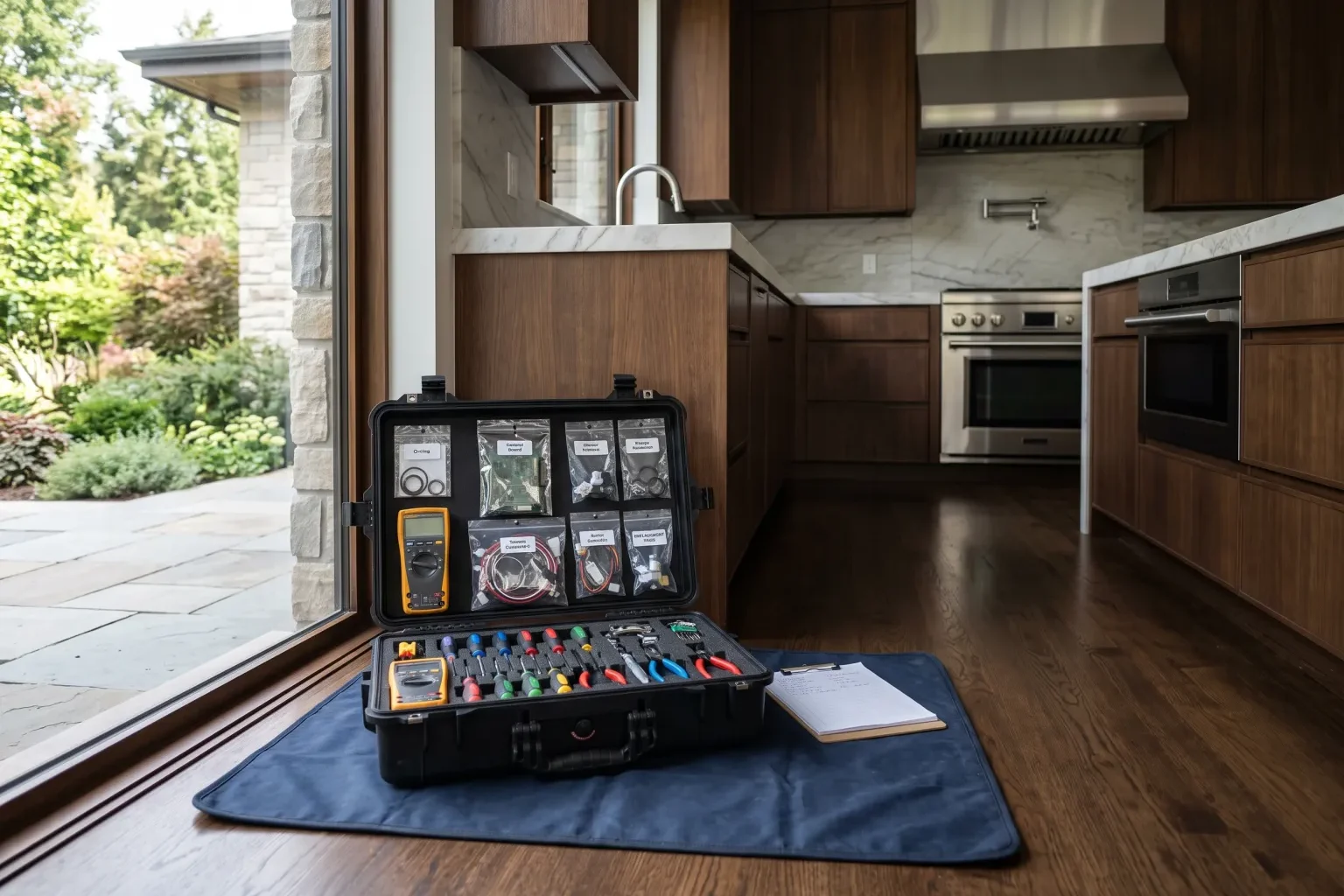
What our technician checks on a built-in unit
A microwave drawer stores high voltage in its capacitor even when it's unplugged, so please don't open the housing yourself. Our technician discharges the high-voltage circuit safely before testing anything inside.
On a heating complaint, we test the magnetron, high-voltage diode, capacitor and transformer, along with the control board signals that tell them when to run. We also inspect the waveguide cover for grease buildup or burn marks, a common cause of arcing. On a drawer complaint, we check the drawer motor, gear assembly, slides and position sensors, and look for anything blocking travel, such as a warped trim panel or a utensil wedged behind the drawer.
Because the door is the drawer, the interlock switches matter. If they're out of adjustment or failing, the unit may refuse to start or may blow its fuse. We test each switch and confirm the drawer seals properly when closed. Finally, we check the outlet, the cooling airflow around the installation, and whether the unit is mounted level, since an out-of-level cabinet can strain the drawer mechanism over time.
How Viking, Wolf and Thermador drawers differ
Sub-Zero itself builds refrigeration, not microwaves, but we often find a microwave drawer in the same kitchen as a Sub-Zero refrigerator, frequently from Wolf, Sub-Zero's sister brand. The basic layout of a microwave drawer is similar across brands, but what tends to wear out varies with the design and how the unit is used.
On Wolf and Thermador drawers, we commonly see problems with the motorized drawer system and touch controls, including gear wear, sensor faults and panels that stop responding after moisture or cleaning spray gets into the edges. On Viking units, drawer travel problems and control or display faults are frequent calls, along with heating failures as units age. Across every brand, heavy daily use and spills that reach the cavity edges speed up wear on the waveguide cover and drawer seals. We identify your exact model before ordering anything, since parts and procedures vary even within one brand's lineup.
Tell us what your appliance is doing.
Repair or replace a high-end microwave drawer?
Repair is usually worth considering on a premium unit. A replacement drawer has to match your cabinet cutout and trim, and a different model may not fit the opening without cabinet work. Many common failures, including interlock switches, drawer gears, sensors, fuses and control boards, can be fixed for much less disruption than a swap.
Replacement can make more sense when the magnetron and control board have both failed on an older unit, when the cavity is rusted or the interior coating is damaged, or when the needed parts are no longer available. We'll tell you plainly which situation you're in so you can weigh it against the age and condition of the rest of the unit.
What affects the cost of a repair
We don't quote over the phone without seeing the unit, because the price depends on what's actually wrong. The main factors are the fault itself, the parts involved, and how hard the unit is to reach.
A switch or sensor replacement is a smaller job than a magnetron or control board. Parts availability for your specific model also matters. Access is the other big factor: a drawer set into custom cabinetry, an island with tight clearances or a flush installation with panel trim can take more time to remove and reinstall carefully. We explain the cost of the repair before starting any work.
How a service visit works
When you schedule, tell us the brand, model number if you can find it, and what the unit is doing, including any error code. The model plate is usually visible on the drawer frame when the drawer is open.
At the visit, the technician inspects the unit, tests the likely causes and explains what failed. If you approve the repair and the part is on hand, we complete it that day. If the part needs to be ordered, we schedule a return visit to install it. Before leaving, we test heating, drawer travel and controls to confirm everything works as it should.