


The short answer
Most range hood problems come from a worn blower motor, a failed control board or switch, a stuck damper, or clogged filters and ductwork, and nearly all of them can be repaired. On a built-in or professional-style hood, repair is usually the better choice unless the housing is damaged or parts are no longer available.
A range hood is easy to ignore until it stops pulling smoke, starts rattling, or won't shut off. On a professional-style range or rangetop, that matters fast: high-output burners make a lot of heat, grease, and moisture, and a weak hood lets it settle on cabinets and ceilings. Sub-Zero Service Center repairs ventilation hoods in high-end kitchens across Wilmington and nearby cities. We work on the premium appliances found in these kitchens, Sub-Zero, Viking, Wolf, and Thermador. We are an independent repair company and are not affiliated with any of these brands.
Issues we fix
Homeowners usually call us about one of a handful of symptoms. Some point to an electrical fault, others to an airflow problem somewhere between the hood and the outside wall or roof cap. Telling them apart is the first job on any visit.
- Fan won't turn on at any speed, or only runs on one speed
- Weak suction: smoke and cooking smells drift past the hood
- Loud humming, grinding, or rattling when the blower runs
- Lights out or flickering even after replacing the bulbs
- Touch controls or push buttons that don't respond
- Fan that turns on by itself or won't shut off, often tied to a heat sensor
- Grease dripping from the hood or filters
- Downdraft vent that won't rise or lower
- Flapping or whistling from the exterior damper on windy days
What our technician checks on a built-in or professional-style hood
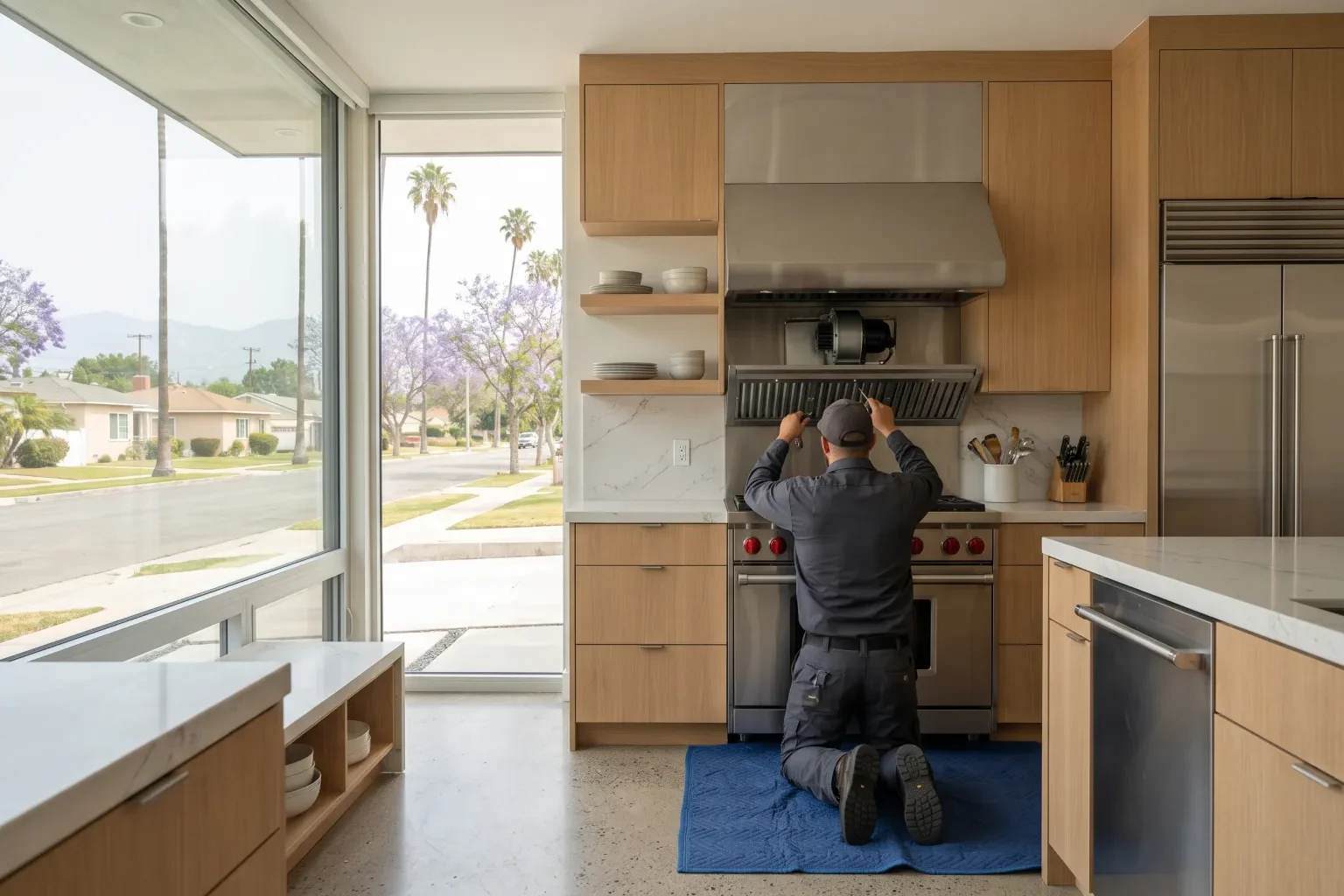
Premium hoods are larger and more complex than a basic under-cabinet unit. Many use high-capacity blowers, and some mount the blower away from the hood, inline in the duct or on an exterior wall or roof. We trace the whole system instead of guessing at the most common part.
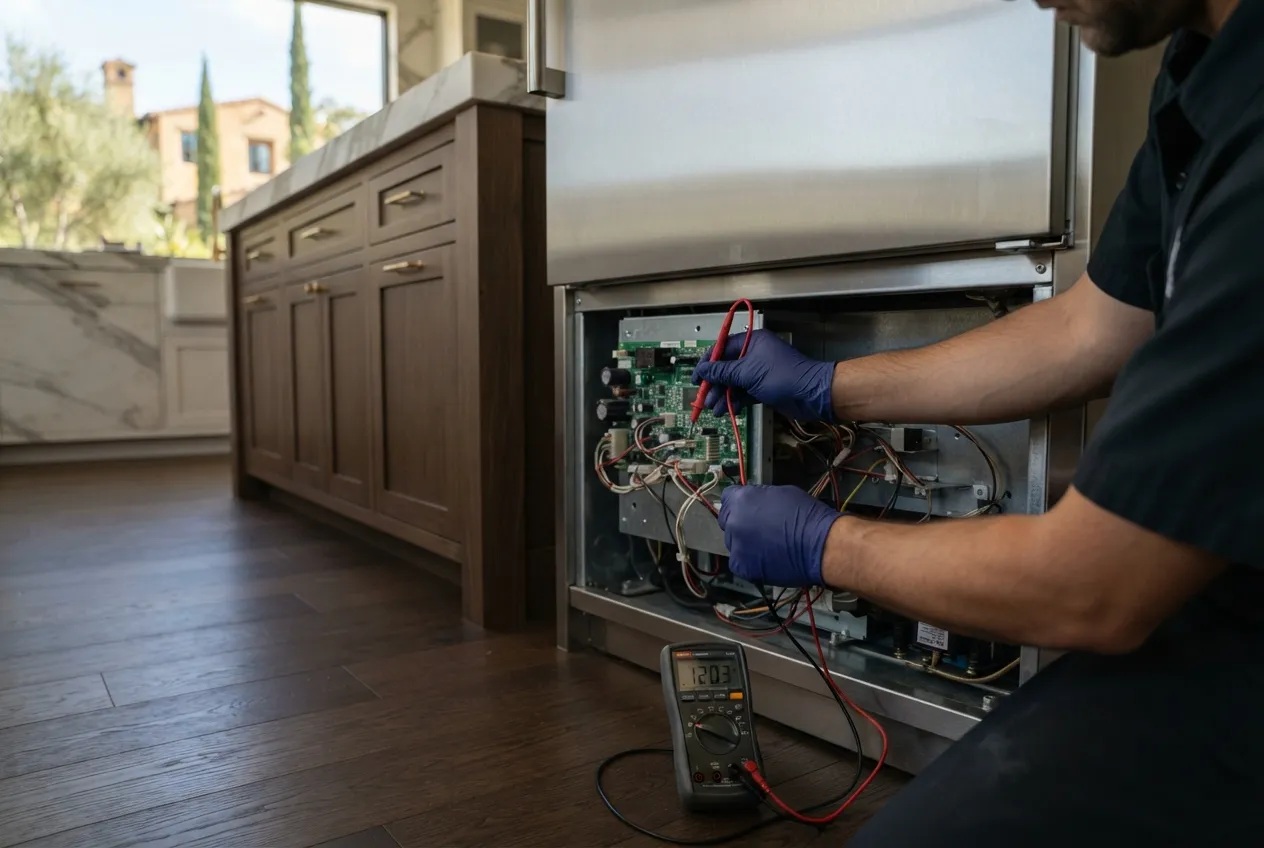
A typical inspection covers the blower motor and fan wheel for wear, imbalance, and grease buildup; the capacitor and wiring; the control board, switches, or touch panel; the light sockets and transformers; and any heat sensor that triggers automatic fan operation. We also look at airflow: baffle or mesh filters, the transition and duct runs, the backdraft damper, and the exterior cap. A hood with a healthy motor can still perform poorly if a damper is stuck or a duct is crushed or packed with grease. Near the coast, we also check exterior caps and dampers for corrosion.
How Sub-Zero, Viking, Wolf, and Thermador hoods differ
Sub-Zero doesn't sell range hoods under its own name. In kitchens built around Sub-Zero refrigeration, the hood is often from Wolf, its sister brand, or from Viking or Thermador to match the range. Each brand's design shapes what tends to go wrong.
Wolf pro and chimney hoods often pair with internal or remote blowers and electronic controls, so control boards, heat-sensing features, and remote blower wiring are common places to look. Viking's professional-style wall and island hoods are heavy-duty units with baffle filters and powerful blowers. On those, we often see motor wear, worn switches, and grease-loaded fan wheels, especially above high-output burners. Thermador hoods frequently use electronic touch controls, and the brand also makes downdraft ventilation. Downdraft units add a lift mechanism and motor, so drive motors and limit switches become part of the picture. Wolf downdrafts share some of those failure points. These are tendencies, not rules, which is why we confirm the fault before ordering parts.
Tell us what your appliance is doing.
Repair or replace a high-end range hood?
A premium hood is often built into custom cabinetry, a plaster surround, or a matched stainless line, and the ductwork is sized to it. Replacing it can mean changing the duct transition, the cabinet opening, or the finish around it, and that is far more disruptive than swapping a motor or board. For most failures, repair makes more sense.
Replacement is worth discussing when the stainless or liner is badly damaged, when key parts have been discontinued with no workable substitute, or when you're remodeling and want different capacity anyway. If your hood is clearly underpowered for your range, we'll tell you so rather than repair it just to keep it running. Either way, we explain what we found and let you decide.
What affects the cost of range hood repair
We give you a clear quote after diagnosis, before any repair work starts. Several factors drive that number.
The fault itself matters most. Cleaning a fan wheel or freeing a damper is a different job from replacing a blower motor or control board. Parts vary widely: brand-specific electronic controls and high-capacity blowers cost more than lamps or switches, and some must be ordered. Access also counts. A hood set into a custom wood or plaster surround, a high island hood, or a remote blower on a roof or exterior wall takes more time to reach safely. If grease buildup in the ductwork is part of the problem, we'll point that out and explain what it involves.
How a visit works
When you contact us, tell us the brand, model if you have it, and what you're noticing. A photo of the rating label, usually behind the filters, helps us prepare. We'll schedule a time that works for you in Wilmington or a nearby city.
At the visit, the technician confirms the symptom, inspects the hood, controls, and airflow path, and explains the cause in plain terms along with a quote. If the part is on the truck, we can often finish the same day. If it needs to be ordered, we schedule a return visit once it arrives. Before we leave, we run the hood through its speeds and lights and show you how to keep the filters and damper in good shape.